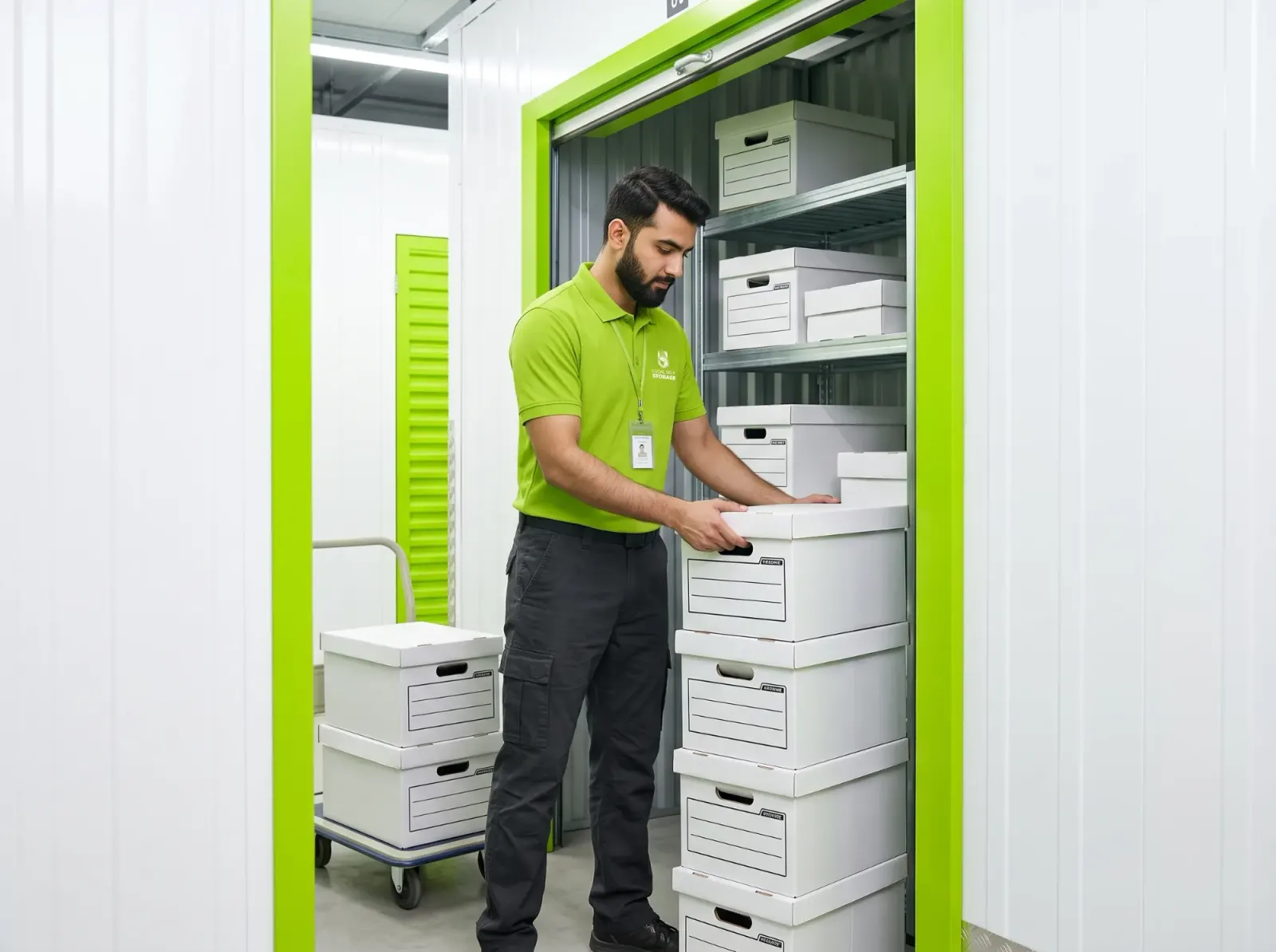
Business growth usually creates a space problem before anyone expects it.
A few extra product cartons become a crowded stockroom. Archived files occupy cabinets that could be used by the team. Exhibition stands, office chairs and promotional materials slowly take over corners, meeting rooms and corridors.
Renting a larger office or warehouse is not always the right answer.
Local Self Storage Dubai provides flexible business storage in Dubai for inventory, archived documents, office furniture, tools, equipment and other approved commercial items. You can use additional space during a busy season, an office move or a longer period of business growth.
Tell us what your company needs to store, how often the items may be required and where they are currently located. We will help you explore an arrangement that fits your operations.
A workspace should support the work being done inside it.
When boxes, files and unused furniture begin spreading through an office, employees have less room to move and organise their daily tasks. Retailers may struggle to separate available stock from returns. Online sellers often find that a spare room or home garage is no longer enough.
Business storage creates a separate place for items that remain important but do not need to occupy your primary working area.
It may help you:
Free desks and meeting rooms
Organise surplus inventory
Keep archived records away from active files
Store furniture during an office change
Hold marketing materials between campaigns
Manage stock during seasonal peaks
Avoid committing to a larger commercial property too early
Separate business products from your home
Keep equipment available for future projects
The right solution depends on how your business works. A company that needs regular stock movement may have different requirements from one storing closed archive boxes for several years.
What Is Business Storage?
Business storage is additional space used by companies, professionals and self-employed people for approved commercial belongings.
It sits between an overcrowded office and the expense of maintaining more permanent premises than the business currently requires.
Companies may use it for:
Product inventory
Online shop stock
Archived documents
Office desks and chairs
Shelving and cabinets
Computers and selected electronics
Tools and work equipment
Exhibition materials
Event supplies
Printed marketing material
Packaging supplies
Product samples
Seasonal displays
Non-perishable commercial goods
Business storage is not the same as a full logistics or fulfilment operation. Businesses that require order picking, product dispatch, pallet handling, hazardous-goods storage or complete supply-chain management should discuss those needs separately.
Who Can Use Business Storage in Dubai?
Additional space can support companies at almost every stage, from a home-based start-up to an established organisation managing several departments.
E-Commerce Businesses
Online sellers often begin with stock kept at home.
That arrangement may work for the first few orders, but it becomes harder once cartons fill bedrooms, hallways or parking areas. Products can become difficult to count, and business deliveries may interrupt family life.
A separate storage arrangement allows the owner to keep inventory outside the home while retaining the flexibility to change space as the product range develops.
Before booking, consider:
Number of product cartons
Frequency of stock deliveries
Frequency of retrieval
Packaging material requirements
Size and weight of individual products
Whether any products require special conditions
Small Businesses and Start-Ups
A new company may not be ready to lease a dedicated warehouse.
Business storage can provide breathing room while sales, staffing and stock levels are still changing. It may be used for product samples, supplies, equipment, files and promotional materials.
This can be particularly useful when a company operates from:
A shared office
A coworking space
A small retail unit
A residential property
A serviced office
A temporary project location
Retailers
Retail businesses may need additional room before promotions, holidays or high-demand periods.
Storage can be used for approved surplus inventory, shop fittings, decorations, display stands and packaging materials. Once the seasonal period ends, the business can reassess how much space is still required.
Professional Offices
Law firms, consultancies, agencies, property companies and other professional offices often accumulate documents, furniture and outdated equipment.
Moving inactive items away from the main office can help create a tidier environment without forcing the company to dispose of materials that must still be retained.
Maintenance teams, installers, decorators and event companies may need room for tools, display materials, non-hazardous supplies and equipment that is not used every day.
The business should provide a detailed inventory before booking, particularly when items are heavy, unusually shaped or subject to storage restrictions.
Companies Moving or Renovating
Office changes rarely happen in one clean step.
The new location may not be ready when the old lease ends. Furniture may arrive before fit-out work is complete. Equipment might need to be removed while flooring, painting or electrical work is underway.
Temporary business storage creates a holding point until the workplace is ready.
Inventory Storage for Dubai Businesses
Inventory is one of the most common reasons companies need additional space.
Stock stored without a clear system can quickly become difficult to count and retrieve. Before placing products into storage, create an inventory structure that matches how your team works.
A basic system may include:
Product name
SKU or reference number
Carton number
Quantity per carton
Date added
Batch or collection
Storage location
Condition notes
Person responsible
Place clear labels on more than one side of each carton. Avoid vague descriptions such as “mixed items” or “shop stock,” particularly when several team members may need to locate products.
Frequently required goods should be placed differently from slow-moving inventory. Explain your access needs before the unit or storage arrangement is selected.
Office Furniture Storage
Desks, chairs, cabinets and meeting-room furniture can remain useful even when they are not needed at the current location.
A company may be:
Moving into a smaller office
Waiting for a new branch to open
Replacing furniture in stages
Renovating its workplace
Closing a temporary project office
Keeping furniture for future employees
Reorganising departments
Furniture should be assessed before transportation. Large desks and cabinets may need dismantling, while polished surfaces, glass panels and upholstered chairs require suitable protection.
Paper records take up more room than many businesses realise.
A few folders become multiple cabinets, and old cabinets remain in the office because nobody has time to sort them. However, transferring records into storage without an index creates another problem: staff may know the documents exist but not where to find them.
Before storing archives:
1
Separate active and inactive records.
2
Remove duplicate material where permitted.
3
Follow your company’s document-retention policy.
4
Label each archive box clearly.
5
Create a searchable index.
6
Record destruction or review dates where applicable.
7
Restrict access to authorised team members.
Businesses remain responsible for their legal, regulatory and privacy obligations. Storage should support an existing document-management process rather than replace one.
Exhibition and Marketing Material Storage
Exhibition stands, banners, display counters and printed materials may only be used several times each year, yet they can occupy valuable office space between events.
Business storage may provide a practical place for:
Pop-up stands
Banners
Display units
Brochure cartons
Branded decorations
Event furniture
Product samples
Promotional gifts
Reusable signs
Inspect everything after each event. Damp fabric, damaged packaging or unclean equipment should not be placed directly into storage.
Record the event kit as a complete set so missing components can be identified before the next exhibition.
Short-Term Business Storage
Short-term arrangements are useful when the requirement has a clear beginning and end.
Examples include:
Office renovation
Temporary closure
Property handover
Stock overflow
Exhibition preparation
Seasonal product demand
Delayed office fit-out
Short commercial projects
Furniture replacement
Even when the expected period is brief, allow for possible delays. Ask how the arrangement can be extended if your office, shipment or project is not ready on schedule.
Long-Term Commercial Storage
Some business items are retained for months or years.
Longer storage may be suitable for archived documents, spare furniture, slow-moving stock, reusable displays and equipment kept for future projects.
Long-term arrangements require stronger organisation than temporary storage. The person who creates the inventory may leave the company, departments may change, and product references may be updated.
Use a shared company record rather than relying on one employee’s private notes.
Review the stored inventory periodically and remove items that no longer have a commercial, operational or legal reason to be retained.
The Process
How Business Storage Works
1
Explain the Business Requirement
Tell us what the company needs to store and why additional space is required.
Useful details include:
Type of business
Item categories
Number of cartons
Furniture dimensions
Expected storage period
Current location
Delivery or collection needs
Expected access frequency
Heavy or fragile items
Any special handling considerations
2
Assess the Required Space
Storage should be based on volume and operational use, not only floor area.
A tightly packed archive has different space requirements from furniture that cannot be stacked. An e-commerce company retrieving products regularly may need a more accessible arrangement than a company storing sealed records.
We consider the type, quantity and shape of the items before discussing a suitable option.
3
Review the Service Details
Before confirming, review:
Storage period
Payment schedule
Access procedure
Notice requirements
Collection or delivery charges
Packing requirements
Restricted items
Insurance responsibilities
Conditions for changing space
End-of-storage process
4
Prepare and Label the Items
Each carton should have a clear business reference.
Furniture and equipment should be clean, dry and packed for handling. Loose parts, cables and assembly hardware should be placed in labelled bags and linked to the relevant item.
Do not place unlisted goods into sealed cartons after the inventory has been completed.
5
Arrange Transportation
Collection, loading and transportation requirements depend on the item volume, access conditions and service arrangement.
For office buildings, provide information about:
Loading-bay access
Lift bookings
Building management approval
Parking restrictions
Permitted moving times
Floor number
Long carrying distances
Security registration
6
Maintain an Updated Inventory
Record every item entering or leaving storage.
For stock, update quantities after each movement. For documents, note the box reference and authorised person. For furniture, record the condition and number of separate pieces.
A reliable inventory saves far more time than it takes to create.
Missing access information can cause delays on collection day.
Choosing the Right Amount of Space
Businesses often make one of two mistakes: booking too little space or paying for a large empty area that is not required.
Consider:
Current item volume
Expected stock growth
Ability to stack cartons
Shelf or racking requirements
Size of furniture
Need for walkways
Retrieval frequency
Number of future deliveries
Fragile or crushable goods
Space needed to sort items
An online seller with fast-moving products may need an organised aisle. An office archive that is rarely accessed may be packed more compactly.
Tell us how the stored items will be used, not merely what they are.
Items That May Not Be Suitable for Storage
Storage restrictions should always be confirmed before booking.
Commonly restricted items may include:
Flammable products
Explosives
Gas cylinders
Hazardous chemicals
Perishable food
Illegal goods
Weapons
Unsealed liquids
Waste materials
Live plants or animals
Damp goods
Strong-smelling products
Pest-infested items
Controlled substances
Dangerous materials
Businesses should not assume that an ordinary storage unit is approved for chemicals, pharmaceuticals, food, dangerous goods or temperature-sensitive products.
Disclose the exact nature of commercial inventory before signing an agreement.
Security, Access and Responsibility
Security is an important part of business storage, but companies should look beyond a single marketing phrase.
Before booking, ask about:
Facility access controls
CCTV coverage
Visitor procedures
Unit-locking arrangements
On-site support
Fire-detection systems
Pest-control practices
Access records
Permitted access hours
Insurance options
Emergency procedures
The business should also control who is authorised to visit, retrieve or add items.
Avoid giving access information to a broad group of employees. Keep an internal record of authorised personnel and update it when roles change.
Local Self Storage Dubai will explain the relevant arrangement and available facility information during the quotation process.
Business Storage Costs in Dubai
The cost depends on the actual requirement rather than the business name or industry alone.
Pricing factors may include:
Space required
Storage duration
Facility or unit type
Access requirements
Item category
Collection and transportation
Packing materials
Furniture dismantling
Handling requirements
Insurance
Additional deliveries
Return transportation
A low headline price may not represent the full monthly or moving cost.
Ask for a written quotation showing the included services, recurring charges and any one-time costs.
Why Choose Us
Why Choose Local Self Storage Dubai?
Local Guidance
We focus on practical storage requirements faced by businesses operating in Dubai.
Space Based on Operational Needs
Recommendations consider the item volume, retrieval pattern and expected duration.
Support for Different Business Stages
Storage can serve a new online seller, a growing retail company or an established office managing surplus assets.
Related Storage Services
Businesses can arrange support for inventory, documents and office furniture through relevant service options.
Clearer Planning
We encourage detailed inventories, accurate access information and a review of costs before the arrangement begins.
Flexible Use Cases
Use additional space during a temporary project, seasonal peak, office move or longer period of growth.
FAQs
Frequently Asked Questions
What can a business place in storage?
Businesses may store approved inventory, archived records, office furniture, supplies, equipment, displays and marketing materials. Restricted and specialised goods must be disclosed in advance.
Is business storage suitable for an online shop?
It can be suitable for approved non-perishable inventory and packaging supplies. Explain how often you receive and retrieve stock before choosing the space.
Can we store company documents?
Yes, subject to the storage arrangement. Businesses should organise, index and label records before transfer. Visit our document-storage page for more information.
Can office furniture be collected?
Collection and transportation requirements can be discussed during the quotation process. Provide furniture details and information about building access.
Can we use storage for only a few months?
Short-term arrangements may be available for renovation, relocation, stock overflow and temporary projects.
Can the space grow with our business?
Ask about the process for changing the storage arrangement if your inventory increases or decreases.
How should we organise inventory?
Use product references, numbered cartons and a shared digital inventory. Record every stock movement and keep frequently used products accessible.
Is business storage the same as warehousing?
No. Standard business storage provides space for approved company belongings. Warehousing may involve pallets, stock management, fulfilment, loading equipment and logistics services.
Can we store food or chemicals?
Do not assume these products are accepted. Food, chemicals, flammable goods and regulated materials may be prohibited or require a specialist facility.
How do we receive an accurate quote?
Provide an item list, carton quantities, measurements, photographs, expected duration and access requirements.
Keep Your Workplace Focused on Work
Your office does not need to become an archive room. Your home does not need to become an online shop warehouse. Useful furniture does not need to be discarded simply because it is not required this month.
Business storage gives your company room to operate while keeping important items available for future use.
Share your inventory, location and expected storage period with Local Self Storage Dubai. We will help you review the space, handling and access requirements before you make a decision.